
Imagine standing in front of an old stone sculpture that may be too fragile to move. A museum wants to preserve a digital version, but ordinary photographs cannot fully communicate its depth, proportions, and shape. One possible solution is to photograph the sculpture from many different angles and use specialist software to reconstruct it digitally. This process is known as photogrammetry.
For designers, researchers, architects, and digital artists, understanding what is photogrammetry opens up an interesting way to document physical spaces and objects. It turns a collection of two-dimensional images into a three-dimensional representation without requiring the subject to be physically altered.
A Camera Becomes a Measurement Tool
Photogrammetry is a technique that uses photographs to extract information about the shape, position, and dimensions of real-world subjects. Instead of relying on a single image, the process uses multiple overlapping photographs taken from different viewpoints. The software examines visual features that appear in more than one photograph. These might include corners, surface patterns, small marks, or other recognizable details. By comparing their positions across images, it estimates where the camera was located and how points on the subject relate to one another in three-dimensional space.
The result can be a point cloud, which is a collection of points representing the subject’s surface. Further processing can turn that data into a mesh, while photographic information may be used to apply realistic colours and textures. In simple terms, photogrammetry allows software to interpret a subject from multiple photographic perspectives and build a digital model from the information.
Reconstructing an Object Requires More Than Taking Pictures
Return to the sculpture in the museum. The photographer cannot simply stand in one place and take a dozen nearly identical shots. Each photograph needs to contribute a different view while sharing enough visible detail with neighbouring images. The process generally begins with planning the coverage. The photographer moves around the object, capturing its front, sides, rear, upper areas, and accessible lower sections. Overlapping images are important because the software needs common visual details to connect one photograph with another.
Once the photographs are collected, processing software identifies matching features and estimates camera positions. It then calculates the spatial relationships between those points to create an initial reconstruction. The model can be refined by removing unwanted background information, filling suitable gaps, generating surface geometry, and adding texture. This is not always an instant process. A large collection of high-resolution photographs can require considerable computing power and processing time. The quality of the original images also has a direct influence on what the software can reconstruct.
Where Photogrammetry Finds a Place Outside Photography
One of the reasons this technique has become useful across different industries is its flexibility. It does not belong exclusively to photographers or visual-effects artists. In archaeology, researchers can document excavated objects and sites before conditions change. A digital model gives teams a record that can be studied, shared, and revisited without repeatedly handling fragile discoveries. Architects and construction professionals may use photogrammetry to document existing buildings, examine structural features, or create visual records of a site. Depending on the project and measurement controls, reconstructed data can support planning and inspection activities.
Game developers and filmmakers also use the technique to create digital assets from real-world environments. A photograph-based reconstruction can provide detailed textures and natural surface variation that would otherwise take considerable time to create manually. For small businesses, artists, and product designers, it can offer another way to build references for visualisation, concept development, and digital presentation.
Details That Can Make Reconstruction Difficult
Photogrammetry is powerful, but it depends on the quality of the photographic evidence. A subject with distinctive surface patterns usually provides more useful matching features than a completely plain object. Reflective metal, transparent glass, and glossy plastic can be troublesome because their appearance changes with the camera angle and surrounding light. Moving objects may also create inconsistencies between photographs. Even a person walking through a scene during image capture can complicate reconstruction.
Lighting deserves particular attention. Strong shadows or major changes in brightness may make the same surface appear different across images. A stable environment and consistent exposure settings generally make the process easier. Scale is another consideration. A reconstructed model does not automatically provide dependable real-world measurements. Including a known reference dimension or suitable scale marker can help establish size, while projects requiring precise measurements should use appropriate calibration and independent checks.
Photogrammetry Alongside Dedicated Scanning Equipment
Photogrammetry is not the only way to create digital representations of physical objects. Dedicated 3D scanners collect spatial information through technologies designed for capturing surface geometry. This is why discussions about 3d scanning vs photogrammetry often focus on the project’s measurement requirements, subject material, working conditions, and desired output. Some projects can benefit from combining the approaches. Photographs may preserve visual information, while a suitable scanner can contribute geometric data. The datasets can then be used together where the software and workflow support it.
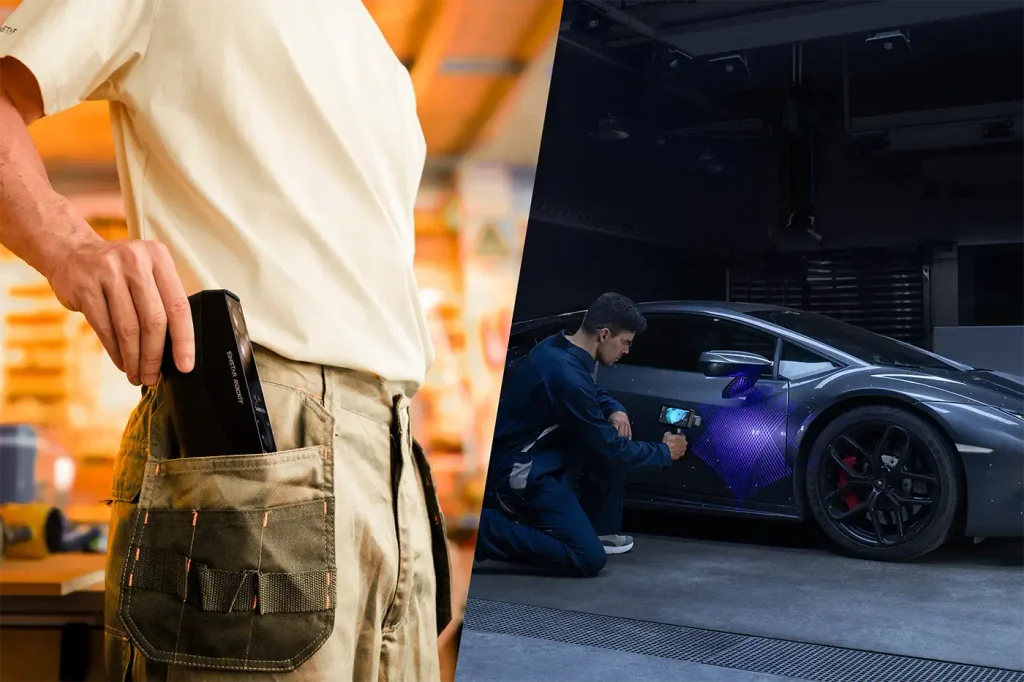
For anyone exploring dedicated capture equipment, EINSTAR provides another route into digital 3D documentation. The important point is to understand the task before selecting a tool. A historic building, a mechanical component, and a textured sculpture do not necessarily require the same capture method.
Conclusion
Photogrammetry gives ordinary photographs a role beyond visual documentation. By analysing overlapping images, software can estimate spatial relationships and reconstruct objects, structures, and environments as digital models. Its applications range from archaeology and architecture to entertainment and product development. The method works best when image coverage, surface detail, lighting, and scale are considered carefully. Once its strengths and limitations are understood, photogrammetry becomes a practical way to preserve physical details and make real-world subjects available for digital study.
Frequently Asked Questions
What equipment is needed for photogrammetry?
A suitable camera or smartphone, stable photographic conditions, and photogrammetry software are the basic requirements. More demanding projects may need higher-quality cameras, lighting equipment, and scale references.
Can photogrammetry work with a smartphone?
Yes. Modern smartphones can capture photographs suitable for many small and medium-sized projects. Results depend on image quality, camera consistency, lighting, and sufficient overlap between pictures.
How many photographs are needed to create a 3D model?
There is no universal number. A simple object may require relatively few images, while a complex subject or large environment needs considerably more coverage. Overlap and viewing angles matter more than following a fixed photo count.
Is photogrammetry suitable for 3D printing?
Yes. Photogrammetry software can create meshes that may be prepared for 3D printing. The resulting model should be checked for gaps, unwanted surfaces, scale, and mesh errors before printing.
Does photogrammetry always produce accurate measurements?
No. Accuracy depends on image quality, camera calibration, scale references, processing, and the conditions in which photographs were taken. Measurement-critical projects should include independent verification.
Also Read

